AEJMC Network

Networking Home for Divisions and Interest Groups

Shared web space for AEJMC DIGs

  • Home
  • Membership
    • Members Sites
    • FAQs
    • Contact Us
  • WordPress
    • An overview
    • Terms of use
    • User privilege levels
      • Administrator policy
      • Administrator agreement
    • WordPress security
    • Lost password
    • WordPress themes
      • Maintaining appearances
    • WordPress plugins
    • Posting video
    • WordPress news & facts

Archives for October 2015

Tips from the AEJMC Teaching Committee

October 27, 2015 by Kyshia

The Device Du Jour Is Changing and Challenging
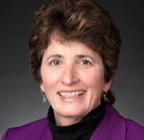
Amy FalknerBy Amy Falkner
AEJMC Standing Committee on Teaching
Senior Associate Dean for Academic Affairs
S.I. Newhouse School of Public Communications
Syracuse University
apfalkne@syr.edu


(Article courtesy of AEJMC News, September 2015 issue)

This is my last Teaching Tips column and I couldn’t be more jazzed. Not because I’m almost done — writing 800 words every once in awhile isn’t too taxing — but because of what I learned at the AEJMC San Francisco Conference. I am cycling off the Standing Committee on Teaching after two wonderful terms where I had an opportunity to think, discuss and judge great teaching. But, mostly, learn a lot.

To wit, I will share with you some great teaching resources and insights from the San Francisco Conference. If you are like me, your head was spinning when you got back with all the things you heard that you wanted to immediately incorporate into your fall courses. I’m writing this in mid-August but you are reading this in September and hopefully well on your way. If not, there is always time to adjust.

This dizzying effect may have taken hold while trying to follow #aejmc15 on Twitter during the conference. Yes, we were trending at one point. The good news is all those thousands of tweets are still available and — after you sort out the snapshots of the Golden Gate Bridge — very valuable. They are chock full of links to terrific graphics, articles and complete presentations as well as pithy food for thought on what we should be talking about in the classroom.
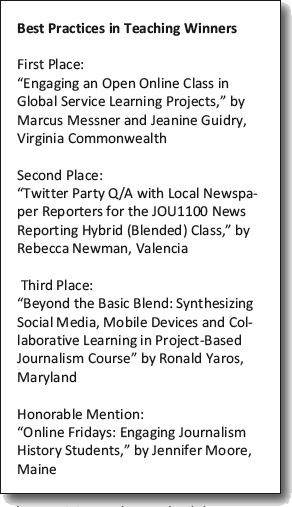
2015 best practices winnersOne of your pit stops should also be the AEJMC website and the Teaching Resources link (under the “Resources” heading). There you will find the last nine Best Practices in Teaching booklets, including the latest on Best Practices in Teaching Online and Blended Learning.

The conference presentations by this year’s winners blew me away. Perhaps it is also because my school has just launched a new online master’s program and I have been wrestling this summer while planning my course with the what-do-I-teach-live versus recorded question. I am fortunate that the platform we are using is super interactive, but if you are at a school where that is not the case, the innovations of the winning professors (listed in box, right) will provide inspiration. There are tools you would expect — Facebook, Twitter, Instagram, Google Hangouts, WordPress, Blogger — with inventive means to an end.

I also heard about new ways of student learning from Ron Yaros, Maryland, one of the contest winners, who teaches using an app called Nearpod that his students access during live class on tablets or smartphones. No laptops allowed. On purpose. Ron has been testing how students best learn and some of that is to eliminate multitasking and distractions.

So maybe the device du jour is changing and that is part of our challenge — both in what we teach and how we teach it. Do we need to learn every new app and teach it in class? No, we’d lose our family, offline friends and probably our sanity if we invested every waking hour to that. But getting a handle on what new (and potentially free) tools our students can use related to analytics and, in particular, measuring social media was a theme I heard echoed in several panels and across disciplines.

Full disclosure: I am in the Advertising Division so my POV on POE (point of view on paid, owned, earned may differ from yours) but a fascinating panel on that topic put together by Patricia Mark, South Alabama, gathered quite a crowd at 8:15 a.m. on Friday of the conference. Penn State’s Marcia DiStaso made a great presentation titled “Data Science Changes in the Classroom” that included free analytical tools such as SimplyMeasured, Followerwonk, SumAll, Quintly, Cyfe and Keyhole that may (or may not) be familiar to you. Her slide on this has been tweeted and retweeted for good reason, including by me (@amyfalkner if you need it).

The last panel I will mention was led by (shameless plug alert) Newhouse’s Beth Egan on the topic of native advertising, which is Beth’s area of expertise and fertile ground for debate among the Ad, PR and journalist types in the room. The panel included Steve Rubel, EVP of Global Strategy and Insights at Edelman, who basically told the crowd that native is (and has been) happening for years, and too bad if we don’t like it. He also said publishing companies don’t matter much, mobile is the sun and all other platforms are planets, and that consumers will sort out the ethics of native advertising. That last snippet caused a kerfuffle. Is that the job of consumers? Shouldn’t we be teaching students the ethics of this?

So that trail eventually led to a discussion among the Teaching Committee to consider “teaching ethics in relation to emerging media” as our next teaching contest. It isn’t finessed or finalized yet, but look for the call explaining the next topic in the near future. Then mark your calendars for Aug. 4-7, 2016, in Minneapolis and be sure to add the Best Practices in Teaching session to your mobile app schedule. As for me, I will not need to attend another 7 a.m. meeting for this committee (the only happy part about my term ending), but I will definitely be at that session. #aejmc16 #loveteaching
Teaching Corner

Filed Under: Uncategorized

Tips from the AEJMC Teaching Committee

October 27, 2015 by Kyshia

San Francisco and the Amazing Teaching Race: Get Your #AEJMCPARTAY On!

L AldooryBy Linda Aldoory
AEJMC Standing Committee on Teaching
Director, Horowitz Center for Health Literacy
Associate Professor, Behavioral & Community Health
School of Public Health
University of Maryland
Laldoory@umd.edu

(Article courtesy of AEJMC News, July 2015 issue)

One of the great things about living close to our nation’s capital is the interesting activities you get to see on a regular basis. For example, last week, I happened upon a national scavenger hunt. There was a long line of backpack-clad individuals from across the country waiting on Constitution Avenue to sign up for the day’s adventure and win tons of money. Blue versus green team, families versus singles.

Why can’t AEJMC have a similarly amazing race? Thus, we are proud to present the first-ever, “Professors’ Amazing Race for Teaching at AEJMC, Yeah!” or PARTAY (another thing you learn living in DC is how to make reverse acronyms!). Here is how to play: Below is a list of the amazing teaching sessions available this year in San Francisco. If you attend one session from each of the five categories below, thus collecting five teaching sessions, you win! What do you win? We cannot divulge the top-secret prize until the first day of the conference (since we don’t actually know what it is yet), but it will be highly valuable, I am sure. In addition, we will have set up the Twitter hashtag #AEJMCPARTAY for you to post to when you attend a session so you can share with others what you have learned. We expect a photo, and a quote or two from each session, establishing the fact that you were in attendance. Extra points for live tweeting the entire session! Good luck to everyone who joins the PARTAY!

1. Several pre-conference workshops on Wednesday relate to the new communication landscape. Google, hacking, Facebook, and the digital age—topics of this year’s workshops cover the range of issues that impact mass communication and journalism today. For example, Small Programs Interest Group is sponsoring a workshop from 1 p.m. to 5 p.m. on methods for teaching digital storytelling and for putting courses online. There will be eight panelists from across the country from both education and private industry sharing expert advice. There is also a workshop on teaching traditional journalistic skills, such as how to teach fact checking and accountability. This session will be 8 a.m. to noon, is sponsored by the American Press Institute, and includes a panel of four industry experts and faculty who will share best practices and sample exercises for teaching journalistic reporting. Finally, the Standing Committee on Teaching is hosting a workshop from 1 p.m. to 5 p.m. for adjuncts and instructors on the “nuts and bolts” of teaching journalism and mass communication. This session will include faculty from the committee who will discuss syllabus development, classroom behavior to look out for and how to deal with technology in the classroom.

2. Thursday’s Best Practices in Teaching. At 10 a.m., the Standing Committee on Teaching will host a presentation of the winning entries in the Teaching Best Practices competition. The best cases in online and blended learning include an example of global communication between students from different countries; the use of Twitter to connect students with professionals; the application of social media for collaborative learning; and a look at a journalism history class that used online activities to engage students.

3. Friday’s Big Session on Big Data. Everyone is talking about big data and the Standing Committee on Teaching is having a plenary panel on the implications of big data on teaching journalism and mass communication. The panelists include Edward Carl Malthouse from Northwestern, Deen Freelon from American, Jolie Marting from Pinterest, Thomas Lento from Facebook, and Laurie Thomas Lee from Nebraska Lincoln. Seth Lewis from Minnesota will moderate. The session will dive into the different types and sources of data that relate to our field and the ramifications of using data in teaching and research.

4. Saturday’s Panels on Unique Teaching Topics. Particularly unique are Saturday’s sessions on teaching. For example, the Community College Journalism Association is hosting a panel on how to turn your program into “an experimental lab.” The Magazine and Visual Communication divisions are holding a “Teaching Marathon” with TEN panelists discussing such topics as visual presentation, news literacy, partnering with service-learning organizations to advance visual literacy, and teaching multimedia narrative. Plus there is a session by Law and Policy Division cosponsored with the Entertainment Studies Interest Group on teaching taboo topics.

5. Sunday’s Whopping Ten (10!) Sessions Devoted to Teaching Issues. Starting at 9:15 a.m. and running through 2:15 p.m., several simultaneous teaching panel sessions are being coordinated by several divisions. Media Management and Economics has partnered with Communication Technology on a panel about open educational resources and massive open online courses. The Public Relations Division will be having its top teaching papers presented. Scholastic Journalism and the Internship and Careers Interest Group put together panelists from high schools to discuss teaching digital skills. The Political Communication Interest Group partnered with Communicating Science, Health, Environment and Risk Division to present on innovative methods for student engagement. Late morning, there are three simultaneous teaching panels. The Community College Journalism Association and the Communication Technology Division covers analytics and why it is one of the most important things to teach students. The Commission on the Status of Women and the Gay, Lesbian, Bisexual, Transgender Interest Group have a six-person panel on teaching gender in journalism and mass communication courses. The Entertainment Studies Interest Group and the Electronic News Division will present their panel on “Accessing Hollywood: Using Entertainment News to Foster Learning and Understanding.” Finally, Religion and Media and Small Programs Interest Groups will host a panel on teaching religion writing and working on religion in newsrooms.

With so many options, it will be easy to join the race to PARTAY and tweet the amazing sessions. We look forward to seeing everyone in San Francisco!

Teaching Corner

Filed Under: Uncategorized

AEJMC Network

"AEJMC Network" is the name given to the server space shared by official bodies of the Association for Education in Journalism and Mass Communication.

Search

RSS AEJMC Job Postings

Genesis Theme Support by WebPresence · Copyright © 2026 AEJMC · Log in